The closing ceremony of the 2025 FIDE World Cup unfolded as a celebration worthy of the transformative tournament that preceded it—a gathering that honored not merely the champions but the entire month-long journey that brought 206 competitors from more than 80 nations to this historic moment. As the lights illuminated the final chapter of what has been one of chess’s most demanding and compelling championships, the evening served as a fitting epilogue to a tournament that will resonate through competitive chess for years to come.
Champions Rise, Legacies Begin
The award ceremony represented the pinnacle of recognition for three extraordinary competitors who earned their places in history through relentless excellence and competitive fortitude.
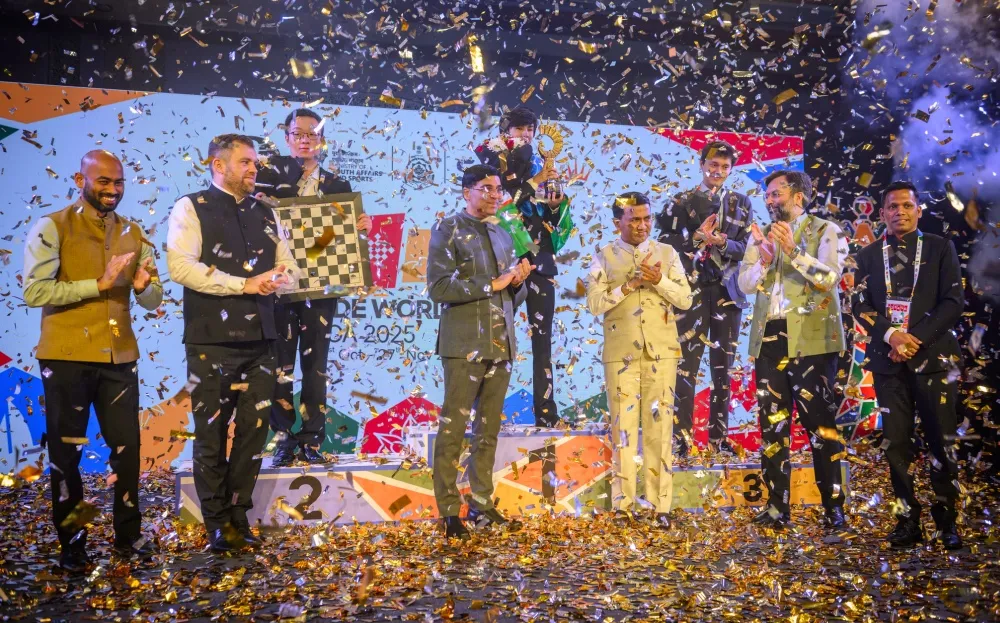
Javokhir Sindarov, at nineteen years old, stepped forward as the gold medalist and 2025 FIDE World Cup Champion. His ascent to the podium to receive the Viswanathan Anand Trophy marked not merely a personal achievement but a historic moment for Uzbekistan’s chess renaissance. The presentation of the gold medal, followed by golden streamers cascading across the stage, captured the magnitude of his accomplishment.
The young champion’s address to the gathering revealed the depth of connection to the tournament’s venue and setting. He spoke of his long and fortunate relationship with India, recalling that he had first visited to compete at age seven, claiming the Under-7 Asian Championships. His return to this land for the 2022 FIDE Olympiad in Chennai, and now to triumph in Goa as World Cup Champion, completed a narrative arc of profound personal significance.
Most poignantly, Sindarov spoke of his genuine happiness in this moment—an authenticity that resonated with the hall and reminded all present that beneath the competitive intensity and strategic calculation lies the pure joy that draws champions to the game. His victory speech reflected both humility and the recognition that this championship represents merely the beginning of what promises to be an extraordinary career.
Wei Yi, China’s elite grandmaster, ascended the stage to receive the silver medal as championship finalist. His tournament performance—navigating seven grueling rounds and reaching the championship final—demonstrated the consistency, composure, and excellence that have established him among the world’s strongest competitors. The recognition afforded to the runner-up underscored the tournament’s respect for his exceptional performance and the dignity inherent in reaching the championship’s ultimate stage.
Wei Yi’s presence on the podium as silver medalist serves as recognition that reaching the final of such a demanding tournament represents an achievement of extraordinary magnitude, one that positions him prominently for future championship pursuits and continued elevation among the world’s elite.
A Global Celebration
The ceremony itself transcended typical award presentations, instead offering a comprehensive celebration of what this World Cup represented to the chess world and to its host nation. The opening remarks by presenters Ash Chandler and Rebekah Watkins framed Goa as the “heartbeat of the chess world” during these transformative weeks—a characterization that captured the convergence of global chess talent and the intensity that defined every day of competition.
The tournament highlights film served as a poignant reminder of the distance traveled from opening rounds to final reckoning. As the commentators noted, it offered the sensation of “reliving the entire World Cup all over again,” providing perspective on the upsets that challenged expectations, the brilliant comebacks, and the raw human emotion that had defined this month-long journey.
The musical and artistic interludes—lantern dancers moving in mesmerizing synchrony and a renowned sand artist’s visual narrative of chess history—elevated the ceremony beyond typical recognition toward genuine celebration of the sport and its cultural significance.
Voices of Leadership and Vision
AICF President Nitin Narang opened substantive remarks with a story of a young player who transformed loss into learning, capturing the essential philosophy of competitive chess: that every move, every mistake, every comeback becomes part of the epic story of how champions are built. The narrative reflected the tournament’s deepest truth—that excellence emerges not from perfection but from the willingness to learn, adapt, and persevere.
Five-time World Champion Viswanathan Anand delivered the keynote address with the perspective of a player whose own career trajectory mirrors the transformation of chess in his nation. Reflecting on becoming India’s first grandmaster in 1988, Anand spoke eloquently about the journey that has transformed chess from an isolated pursuit into a mass sport with passionate adherents across the country.
“Hosting the World Cup here is deeply symbolic,” Anand remarked, acknowledging that the tournament represented not merely a championship event but a culmination of decades of effort to establish chess as central to India’s sporting identity. His emphasis on India’s determination to be not just the ancient home of chess or its current leader, but its future, struck at the heart of what this World Cup represented—a nation asserting its role as a global chess superpower.
A Ceremony of Significance
The presence of the President of Uzbekistan’s congratulatory video for the champion—a recognition that transcended typical tournament acknowledgment—underscored the profound national significance of Sindarov’s achievement. For a nation proud of its chess traditions, the arrival of a nineteen-year-old champion at the World Cup’s summit represented a moment of genuine historical importance.
The playing of the Uzbek national anthem in the hall, the standing ovation for the champion, and the formal proclamation of championship victory by FIDE Deputy President Anand captured all the ceremonial weight that befits the world’s premier chess championship knockout tournament.
Legacy and Perspective
As the formal proceedings concluded and guests moved toward the poolside gala dinner, the evening marked not merely the end of a tournament but the beginning of new chapters in competitive chess. Three new Candidates qualifiers—having proven themselves through the crucible of a month-long knockout event—now prepare for the ultimate championship tournament that will determine who has the right to challenge for the world title.
Javokhir Sindarov departs Goa as World Cup Champion, his triumph representing a watershed moment in his career and a historic achievement for his nation. Wei Yi returns to China as a finalist who reached the sport’s highest competitive stage and demonstrated why he ranks among the world’s elite. Both have earned their places in chess history and their advancement to the Candidates Tournament.
The 2025 FIDE World Cup has concluded, but its impact will reverberate through competitive chess for years to come. A new champion has been crowned. A legacy has begun. The chess world looks forward to what these extraordinary competitors will accomplish next.